


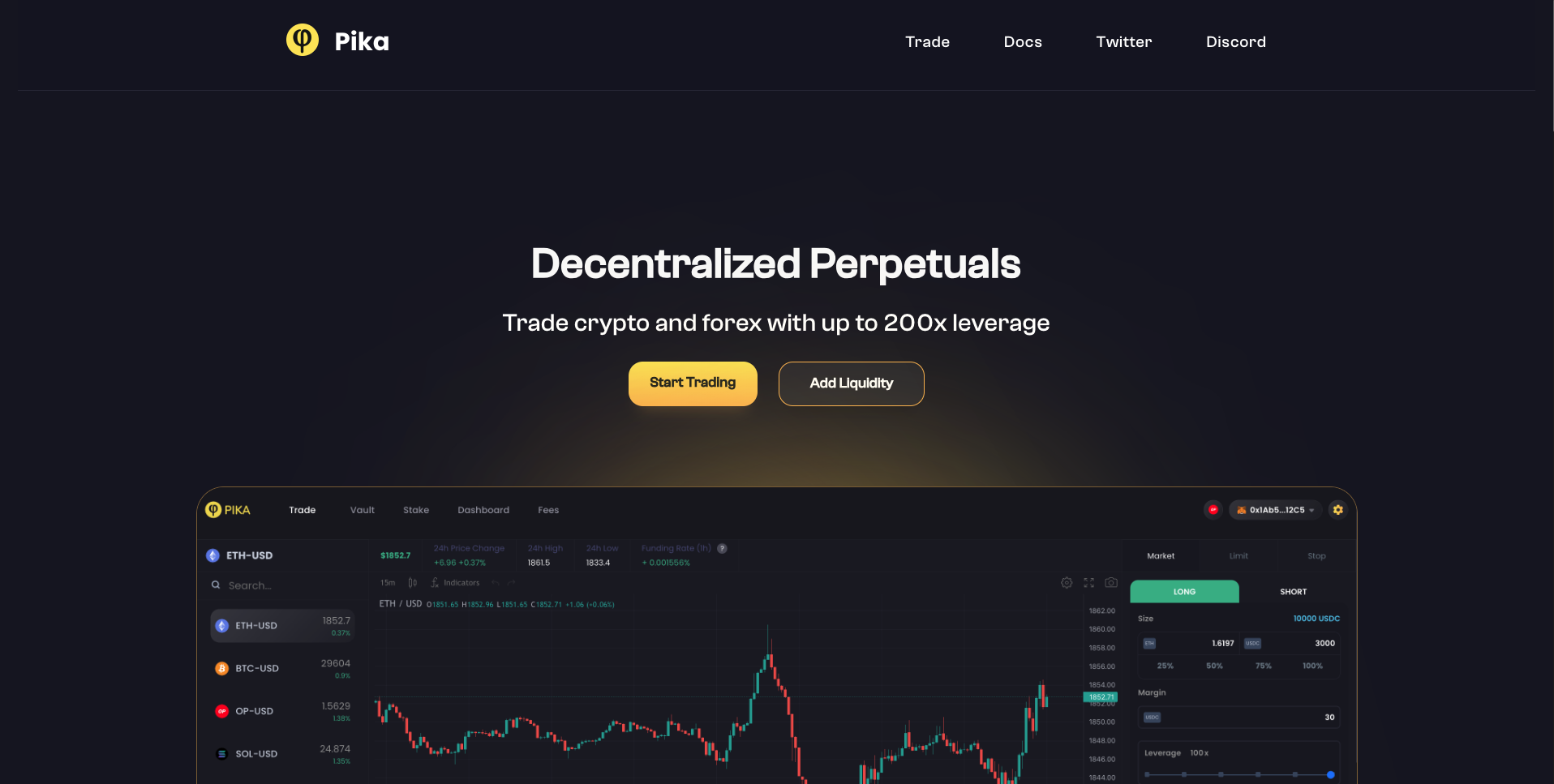
Discover how Pika Protocol's innovative perpetual swaps platform on Optimism enables unprecedented 200x leverage trading across crypto, forex, and commodities, despite the controversial decision to retire its PIKA token for 3,538 ETH.
Pika Protocol: The Anonymous Success Story Facing Token Retirement
In the high-stakes world of decentralized finance, where transparency and accountability typically reign supreme, Pika Protocol stands as one of the most successful yet controversial platforms, demonstrating that exceptional execution can sometimes transcend conventional wisdom about team disclosure and governance structures. Founded in 2021 by an anonymous developer known only as "Ethan" (@EthanDev6), this Optimism-based perpetual swaps platform has achieved remarkable milestones including over $2 billion in trading volume, 700,000+ trades, and a user base exceeding 300,000 participants.
What makes Pika Protocol particularly intriguing is not just its impressive operational metrics, but the dramatic strategic decision announced in November 2023 to retire the PIKA governance token entirely, allowing holders to redeem their tokens for a share of 3,538 ETH from the protocol treasury. This unprecedented move in the DeFi space raises fundamental questions about token utility, governance structures, and the sustainability of protocol-native tokens in successful trading platforms.
Despite the token retirement announcement, Pika Protocol continues operating as a fully functional trading platform, offering leveraged positions up to 200x on a diverse range of assets including cryptocurrencies, forex pairs, and commodities. This continued operation while phasing out the governance token creates a unique case study in DeFi platform evolution and the separation of operational success from token-based governance models.
Revolutionary Virtual AMM Technology and Multi-Asset Trading
Unprecedented Leverage Through Advanced Market Making
Pika Protocol's technological foundation centers around sophisticated Virtual Automated Market Makers (vAMMs) that enable the platform to offer leveraged trading up to 200x without requiring traditional order book liquidity or counterparty matching. This vAMM approach provides consistent liquidity for perpetual swaps while minimizing slippage even during volatile market conditions that can disrupt traditional trading mechanisms.
The virtual nature of these AMMs means that liquidity is algorithmically generated rather than dependent on individual liquidity providers depositing specific assets, creating more predictable trading conditions while enabling exposure to assets that might not have sufficient on-chain liquidity for traditional AMM models. This approach proves particularly valuable for forex and commodity trading where traditional DeFi platforms struggle to provide adequate liquidity.
The 200x leverage capability represents one of the highest leverage ratios available in decentralized finance, rivaling and often exceeding what's offered by centralized exchanges while maintaining the security and transparency benefits of blockchain-based trading. This extreme leverage enables sophisticated trading strategies and capital efficiency but also amplifies both potential profits and losses for platform users.
Comprehensive Multi-Asset Trading Ecosystem
Unlike many DeFi platforms that focus exclusively on cryptocurrency trading, Pika Protocol offers exposure to traditional financial markets including forex pairs like EUR-USD and commodities, creating a comprehensive trading environment that rivals traditional financial institutions. This multi-asset approach enables portfolio diversification and hedging strategies that extend beyond the cryptocurrency ecosystem.
The platform supports over 25 trading pairs across different asset classes, enabling users to implement complex cross-asset strategies and arbitrage opportunities that wouldn't be possible on single-asset-class platforms. This diversity also attracts traders from traditional financial markets who want exposure to DeFi benefits without abandoning familiar asset classes.
Integration with multiple oracle providers including Chainlink and Pyth ensures accurate pricing across all supported assets while the platform's perpetual swap structure eliminates expiration dates that complicate position management in traditional futures markets. This combination of diverse asset access and simplified position management creates unique value propositions for both retail and institutional traders.
Direct Wallet Trading and Enhanced Security
Pika Protocol's implementation of direct wallet trading eliminates the deposit and withdrawal processes that create friction and security risks on many trading platforms. Users maintain custody of their assets while trading, reducing counterparty risk and enabling faster position adjustments without waiting for fund transfers or facing deposit limitations.
This self-custodial approach aligns with DeFi's core principles while providing user experience improvements that make the platform more accessible to traders accustomed to centralized exchange interfaces. The elimination of deposit requirements also reduces the platform's custody responsibilities while maintaining user control over assets.
Smart contract architecture built in Solidity and audited by CertiK provides security assurances while the open-source codebase with 18 repositories on GitHub enables community review and contribution. Recent development activity including commits as late as May 2025 indicates ongoing platform improvements despite the token retirement process.
Optimism Integration and Layer 2 Advantages
Cost-Efficient High-Frequency Trading
Pika Protocol's deployment on Optimism provides significant advantages for active traders who need to adjust positions frequently or implement sophisticated trading strategies that require multiple transactions. The Layer 2 scaling solution offers near-instant transaction finality with gas costs that are typically 90% lower than Ethereum mainnet, making high-frequency trading strategies economically viable.
These cost savings prove particularly important for leveraged trading where position management, stop-loss orders, and profit-taking often require multiple transactions that could become prohibitively expensive on higher-fee networks. The low transaction costs enable traders to implement more sophisticated risk management strategies without worrying about fees eroding their profits.
Optimism's connection to Ethereum's mainnet provides security inheritance while the rollup architecture ensures that transaction costs remain predictable even during periods of high network activity. This stability proves crucial for traders who need reliable execution costs for strategy planning and risk management.
Strategic OptimismDAO Relationship and Ecosystem Benefits
Pika Protocol's receipt of 900,000 OP tokens from OptimismDAO's governance funding program in August 2022 demonstrates institutional recognition and support from the Optimism ecosystem. This substantial grant provided development resources while creating alignment between Pika's success and Optimism's ecosystem growth objectives.
The relationship with OptimismDAO also provides strategic advantages including early access to Optimism updates, technical support, and ecosystem integration opportunities that benefit platform development and user experience. These advantages help Pika maintain competitive positioning while leveraging Optimism's continued development and adoption.
However, the substantial OP token grant has also created some controversy, particularly given the anonymous nature of the founding team and questions about the verification processes used to approve such large ecosystem grants. This controversy highlights broader challenges in DeFi ecosystem governance and grant allocation processes.
Cross-Chain Integration and Interoperability
Through partnerships with protocols like LiFi, Pika Protocol enables cross-chain interactions that allow users to access the platform from different blockchain networks while maintaining the cost and speed advantages of Optimism execution. This interoperability expands the potential user base while reducing barriers to platform access.
The integration with The Graph for data indexing improves platform efficiency and enables better user interfaces while TradingView integration provides professional-grade charting tools that enhance the trading experience. These integrations demonstrate sophisticated thinking about user experience and platform functionality beyond core trading mechanics.
Future cross-chain developments could expand Pika's reach while the current Optimism focus provides deep integration advantages and ecosystem benefits that help differentiate the platform from competitors deployed across multiple chains with less specialized optimization.
Token Economics and the Historic Retirement Decision
PIKA Token Distribution and Utility Model
The PIKA token was designed with sophisticated tokenomics that allocated 30% to platform rewards distributed as escrowed PIKA (esPIKA) over three years, 20% to growth funding, 20% to core contributors and advisors with two-year vesting, 19% to the Token Generation Event, and 11% to retroactive and future airdrops. This distribution model emphasized community participation while providing sustainable funding for development and operations.
Token utilities included governance participation through the Pika DAO, staking rewards comprising 30% of trading fees and 10% of monthly esPIKA distributions, and reward allocations where traders received 55% of monthly distributions, liquidity providers received 35%, and stakers received 10%. This utility structure created multiple incentive mechanisms for different types of platform participation.
The esPIKA system implemented sophisticated vesting mechanisms with a 90% initial redemption fee that decayed to zero over one year, with fees directed to the protocol treasury. This approach balanced immediate liquidity needs with long-term holding incentives while providing sustainable funding for platform operations and development.
The Unprecedented Token Retirement Strategy
The November 2023 announcement to retire the PIKA token and allow holders to redeem tokens for ETH from a treasury containing 3,538 ETH represents one of the most dramatic strategic pivots in DeFi history. This decision effectively acknowledges that the platform's operational success doesn't require a governance token while providing immediate liquidity to token holders.
The retirement process enables PIKA holders to claim their proportional share of the ETH treasury, essentially converting governance token ownership into direct platform equity claims. This approach eliminates the complexities and costs associated with token-based governance while providing clear value realization for community members who supported the platform during its growth phase.
This strategy raises fundamental questions about the necessity of governance tokens for successful DeFi platforms, particularly those with clear operational mandates and established user bases. The decision suggests that token-based governance may create more complexity than value for certain types of platforms, particularly those focused on trading infrastructure rather than community-driven protocol development.
Market Performance and Valuation Dynamics
PIKA's market performance reflects both the platform's operational success and the uncertainty created by the token retirement announcement. Trading at $0.4254 with a market capitalization of approximately $8.08 million, the token has experienced significant volatility including a decline from its all-time high of $1.26 but substantial recovery from lows near $0.003426.
The dramatic price movements illustrate the complex dynamics affecting tokens undergoing retirement processes, where traditional valuation models become less relevant as the token's utility shifts from governance and rewards to redemption rights for underlying treasury assets. Daily trading volume of approximately $468 reflects limited liquidity that amplifies price volatility.
The token's current market capitalization relative to the 3,538 ETH treasury available for redemption creates interesting arbitrage dynamics for sophisticated investors while the retirement process provides a natural price floor based on the underlying ETH value. This unique situation offers valuable insights into token valuation during strategic transitions.
Comprehensive Trading Ecosystem and User Experience
Advanced Reward Systems and Community Incentives
Pika Protocol's reward distribution system creates sophisticated incentive structures that align different user types with platform success while encouraging active participation across multiple platform functions. The monthly distribution of esPIKA rewards allocates 55% to active traders, 35% to liquidity providers, and 10% to stakers, creating balanced incentives that support all aspects of platform functionality.
The trader reward allocation based on trading volume and activity encourages platform usage while the liquidity provider rewards ensure adequate market depth for efficient trade execution. Staker rewards provide additional incentives for long-term token holding and governance participation, though these become less relevant as the token retirement process continues.
The retroactive airdrop program distributed rewards to early users and contributors who helped establish the platform before formal token launch, demonstrating appreciation for community building and early adoption. These retroactive rewards have become increasingly common in DeFi as platforms recognize the value of early community support.
Professional Trading Tools and Interface Design
Integration with TradingView provides Pika Protocol users with professional-grade charting tools and technical analysis capabilities that rival those offered by traditional financial institutions and centralized exchanges. This integration eliminates the need for external charting tools while providing seamless access to advanced trading analysis within the platform interface.
The platform's support for sophisticated order types, position management tools, and risk management features enables implementation of complex trading strategies that might be difficult or impossible on simpler DeFi platforms. These professional-grade features attract experienced traders who require advanced functionality for their strategies.
User interface design prioritizes both accessibility for newcomers and functionality for experienced traders, creating broad appeal while maintaining the advanced capabilities that sophisticated users require. This balance proves crucial for platforms offering extreme leverage where user education and risk management become essential for sustainable operations.
Risk Management and Platform Safety Features
Dynamic liquidity adjustment mechanisms help balance long and short positions while preventing market imbalances that could create systemic risks or unfair trading conditions. These automated systems monitor position concentrations and adjust incentives to maintain healthy market balance without requiring manual intervention.
Funding rate mechanisms charge periodic fees to balance long and short positions, ensuring that market equilibrium is maintained even during periods of directional bias where most traders favor one side of the market. These mechanisms prove essential for perpetual swap platforms that need to maintain balanced exposure.
Liquidation systems protect both individual traders and the overall platform from excessive risk while oracle integration ensures accurate pricing for liquidation decisions. The combination of automated risk management and professional oracle infrastructure creates robust protection against the extreme risks associated with high-leverage trading.
Anonymous Leadership and Platform Governance
The Ethan Enigma and Decentralized Development
The anonymous nature of Pika Protocol's founder, known only as Ethan (@EthanDev6), creates both intrigue and controversy within the DeFi community where transparency and accountability typically receive high priority. This anonymity raises questions about verification processes, particularly regarding the substantial 900,000 OP token grant from OptimismDAO that supported platform development.
Despite anonymity concerns, the platform's operational track record of processing over $2 billion in trading volume without major security incidents or user fund losses provides practical validation of the development team's competence and integrity. This performance-based credibility demonstrates that anonymous teams can potentially deliver exceptional results when properly incentivized and held accountable through transparent operations.
The decision to retire the governance token while maintaining platform operations suggests confidence in the existing technical infrastructure and operational procedures, indicating that the anonymous leadership believes the platform can function effectively without token-based governance mechanisms.
Governance Evolution and Token Retirement Impact
The Pika DAO originally enabled PIKA holders to vote on market listings, protocol upgrades, and other key decisions through decentralized governance mechanisms that aligned community interests with platform development. However, the token retirement process effectively eliminates these governance structures while platform operations continue normally.
This transition from token-based governance to operational autonomy represents an unusual evolution in DeFi platform management, where most projects move toward greater decentralization rather than less. The success of this transition could influence how other DeFi platforms approach governance structures and token utility design.
The elimination of governance overhead and token distribution costs could potentially improve platform efficiency and focus while the centralization of decision-making might enable faster development and strategic pivots. However, this approach also eliminates community input mechanisms that help ensure platform development aligns with user needs and preferences.
Strategic Partnerships and Ecosystem Integration
Oracle Infrastructure and Price Feed Reliability
Pika Protocol's integration with multiple oracle providers including Chainlink and Pyth ensures high-quality price feeds across all supported asset classes while providing redundancy that protects against single oracle failures or manipulation attempts. This multi-oracle approach proves particularly important for a platform offering extreme leverage where price accuracy directly impacts user profits and losses.
The diversity of oracle providers enables support for non-crypto assets like forex and commodities that might not be available through single oracle networks, expanding the platform's addressable market while maintaining pricing accuracy. Oracle integration quality often determines platform success or failure for leveraged trading applications.
Ongoing oracle partnerships and potential expansion to additional providers could enable support for new asset classes while maintaining the pricing reliability essential for user trust and platform sustainability. The strategic importance of oracle relationships continues growing as DeFi platforms expand beyond simple cryptocurrency trading.
Technical Integration and Development Support
Partnerships with infrastructure providers like The Graph for data indexing and LiFi for cross-chain functionality enable Pika Protocol to focus on core trading functionality while leveraging specialized expertise for supporting services. This modular approach helps maintain competitive advantages while avoiding the need to develop all capabilities internally.
The integration approach also enables faster development cycles and reduced operational complexity while providing access to ongoing improvements and innovations from partner protocols. These partnerships often determine whether DeFi platforms can maintain competitiveness as the ecosystem evolves rapidly.
Future partnership opportunities could expand platform capabilities while the current focus on proven infrastructure providers ensures stability and reliability for core platform operations. Strategic partner selection becomes increasingly important as the DeFi ecosystem matures and specialization increases.
Risk Assessment and Strategic Challenges
Token Retirement Uncertainty and Community Impact
The unprecedented decision to retire the PIKA token creates both opportunities and risks that significantly impact the platform's future trajectory. While token holders receive immediate liquidity through ETH redemption, the elimination of governance mechanisms may reduce community engagement and long-term stakeholder alignment with platform success.
The token retirement process could set precedents for other DeFi platforms struggling with token utility and governance overhead, potentially accelerating trends toward operational autonomy and away from token-based governance. However, this approach also eliminates many of the incentive mechanisms that helped drive initial platform adoption and community building.
Success of the token retirement depends on whether the platform can maintain user engagement and community support without token-based incentives, while failure could result in user attrition and reduced platform activity. The outcome provides valuable insights into the role of governance tokens in DeFi platform sustainability.
Regulatory Risks and Compliance Challenges
Pika Protocol's offering of extreme leverage up to 200x on diverse asset classes creates significant regulatory risks as financial authorities worldwide develop frameworks for DeFi platforms and derivatives trading. The anonymous leadership structure may complicate compliance efforts and regulatory relationship building.
The platform's multi-asset approach including forex and commodities could attract scrutiny from traditional financial regulators who oversee these markets, particularly if platform usage scales to levels that might impact traditional market dynamics. Regulatory clarity often determines whether DeFi platforms can achieve mainstream adoption.
Anonymous team structures, while common in DeFi, may become increasingly problematic as regulatory frameworks develop and require clear accountability and compliance reporting. The platform's future may depend on its ability to adapt governance structures to meet evolving regulatory requirements.
Competitive Pressures and Market Dynamics
The perpetual swaps market continues evolving rapidly with new platforms offering innovative features and established competitors improving their offerings to capture market share. Pika Protocol must maintain competitive advantages while managing the disruption associated with token retirement and potential governance changes.
Competition from platforms like dYdX with higher liquidity, GMX with established multi-chain presence, and emerging platforms with novel approaches creates ongoing pressure to innovate and differentiate. Success requires continuous improvement while maintaining the operational excellence that enabled initial platform success.
The platform's extreme leverage offering provides competitive differentiation but also creates risks if market conditions or regulatory changes make such leverage levels unsustainable. Balancing competitive advantages with sustainable risk management remains an ongoing challenge for leveraged trading platforms.
Future Outlook and Strategic Vision
Pika Protocol's future trajectory depends heavily on the successful execution of its token retirement strategy while maintaining the operational excellence and user experience that enabled its growth to over $2 billion in trading volume. The platform's continued operation without governance token incentives represents a unique experiment in DeFi platform sustainability and community engagement.
The technical infrastructure, proven trading volume, and established user base provide strong foundations for continued growth, but the elimination of token-based incentives creates uncertainty about long-term community engagement and platform development funding. Success requires demonstrating that operational excellence and user value creation can sustain platform growth without traditional DeFi token incentives.
For traders and investors evaluating Pika Protocol's prospects, the platform offers access to sophisticated derivatives trading with proven operational track records, but the ongoing token retirement creates uncertainties that require careful consideration. The platform's evolution provides valuable insights into DeFi platform sustainability and the role of governance tokens in long-term success.
The broader implications of Pika Protocol's journey—from anonymous success to token retirement—offer important lessons about DeFi governance, platform sustainability, and the complex relationships between operational success and token-based incentive structures. Whether this approach represents innovative evolution or risky experimentation remains to be determined through continued execution and market response.